

R/V Actea
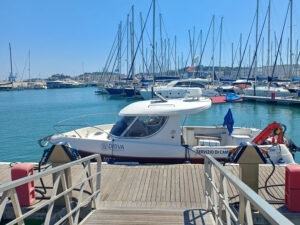 The M/V Actea is a pilot boat model Arvor 250 AS, built by the Polish shipyard JW Slepsk in 2006; ithas a waterline length of 7.5 m, an overall length of 8.3 m, a beam of 2.55 m, and a draught of 0.9 m. It has a 270 hp inboard LVM engine and a 15 hp outboard Mercury auxiliary engine, and it can reach a cruise speed of 18-21 kn (depending on the sea conditions) and a maximum speed of 25 kn. With an average fuel consumption of 50 l/h and a fuel tank of 300 l, its autonomy at cruise speed is about 120 nm. The Actea can host 6 people on board, pilot included, and it is authorized by the Harbor Master’s office to navigate within 6 nm from the coast. It is equipped with: autopilot; VHF; two multifunctional displays (chartplotter, echosounder, sidescan sonar, radar); hydraulic crane with winch and 35 m of wire (max. loading 200 kg); net hauler; pump for seawater; support for current meters; support for macrofauna sieves. Because of its characteristics and equipment, it is feasible to use on board a vast amount of sampling tools, like grabbers, box-corers, Niskin bottles, CTDs, plankton nets, Manta nets, suction pumps, BRUVs, current meters, benthic and/or towed cameras, etc. The main activities carried out with the M/V Actea are: boat sampling of water, sediments and organisms; deployment of instruments and realization of measurements; support to underwater sampling and setting up of experiments through snorkeling and SCUBA diving; sampling methodologies exercises with students; support to institutional events and activities (TV programs, interviews, divulgation projects).
M/B Mytilus
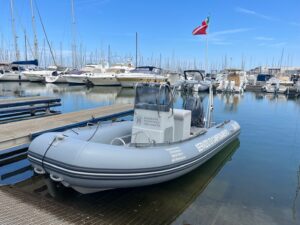 The M/B Mytilus is a RHIB (Rigid Hull Inflatable Boat) model Tempest work/easy 560, built by the Italian shipyard Capelli in 2022; it has a length of 5.6 m, a beam of 2.5 m, and a draught of 0.4 m. It has a 100 hp outboard Yamaha engine and it can reach a cruise speed of 21-25 kn (depending on sea conditions) and a maximum speed of 35 kn. With an average fuel consumption of 20 l/h and a fuel tank of 80 l, its autonomy at cruise speed is about 80-100 nm. The Mytilus can host 7 people on board, pilot included, and it is authorized by the Harbor Master’s office to navigate within 3 nm from the coast. It is equipped with: VHF; multifunctional display (chartplotter, echosounder); six-seater SCUBA tank rack; pump for seawater. Aboard this vessel is feasible to use light sampling tools, like Niskin bottles, plankton nets and CTDs. The main activities carried out with the M/B Mytilus are: boat sampling of water and organisms; realizations of measurements; support to underwater sampling and setting up of experiments through snorkeling and SCUBA diving; sampling methodologies exercises with students; support to institutional events and activities (Tv programs, interviews, divulgation projects).
Aquarium Facilities
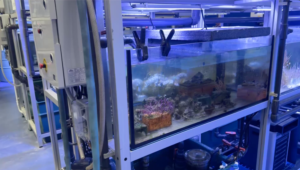 The Aquarium Facility has a total water volume exceeding 25,000 L, distributed among different types of glass and fiberglass tanks, for a total of approximately 200 mesocosms and experimental tanks, the facility is organized into three main areas dedicated respectively to: i) temperate marine species (Mediterranean), ii) tropical marine species, and iii) polar and deep-sea marine species. The entire infrastructure operates as a recirculating system, and it is equipped with advanced water-filtration technologies, specialized lighting systems, and water-treatment units specifically designed to minimize water and energy consumption while maximizing the ability to reproduce natural environmental conditions. The facility therefore provides optimal controlled conditions for both marine vertebrates and invertebrates and supports complex experimental applications at multiple levels. These include the housing and long-term maintenance of species of particular ecological relevance or vulnerability; investigations of life cycles and reproduction in teleosts and marine invertebrates; experimental aquaculture; feeding and nutrition studies; and experiments assessing the effects of multiple stressors, including contaminants, biologically active compounds, and environmental drivers. The facility also enables the experimental simulation of global climate-change scenarios.