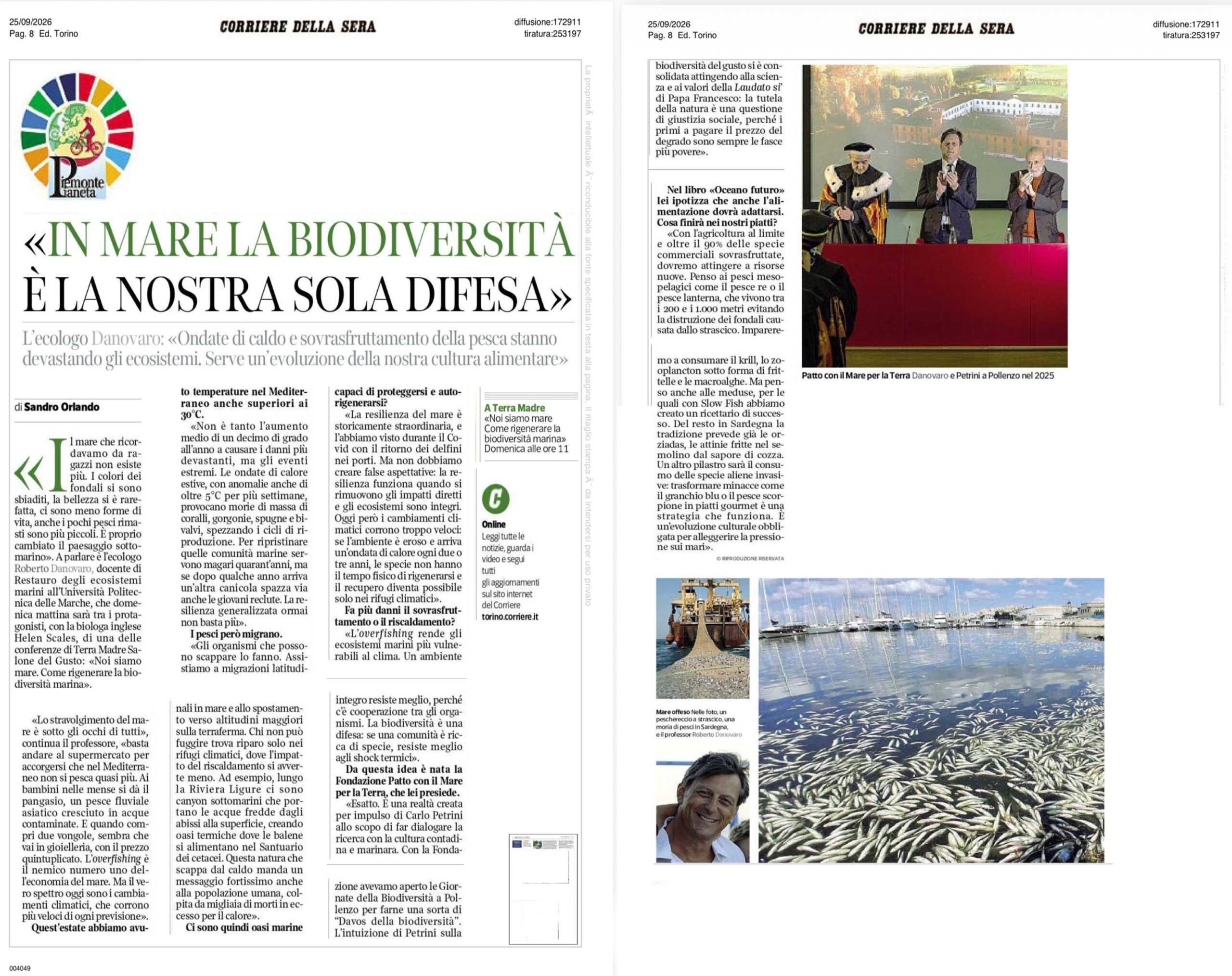
Roberto Danovaro in Corriere della Sera on heatwaves, overfishing and what we’ll be eating tomorrow
The Mediterranean we remember as children is gone. That is how Prof. Roberto Danovaro opens his interview with Corriere della Sera (25 September 2026), published ahead of his talk with marine biologist Helen Scales at Terra Madre Salone del Gusto in Turin.
This summer, parts of the Mediterranean passed 30°C. Heatwaves lasting weeks are killing corals, gorgonians, sponges and bivalves. These communities can take forty years to recover, and the next heatwave arrives in two or three. Overfishing makes things worse: depleted ecosystems cope badly with warming, while species-rich ones hold out.
What does that mean for our plates? With more than 90% of commercial stocks overexploited, Danovaro argues we will have to change what we eat. His suggestions are krill, macroalgae, jellyfish, lanternfish, and invasive species such as the blue crab and the lionfish.
“Turning threats into gourmet dishes works,” he says. “It’s a cultural shift we can’t avoid.”
Read the full interview: S. Orlando, Corriere della Sera, Ed. Torino, 25/09/2026